
· By Nick Fernandez
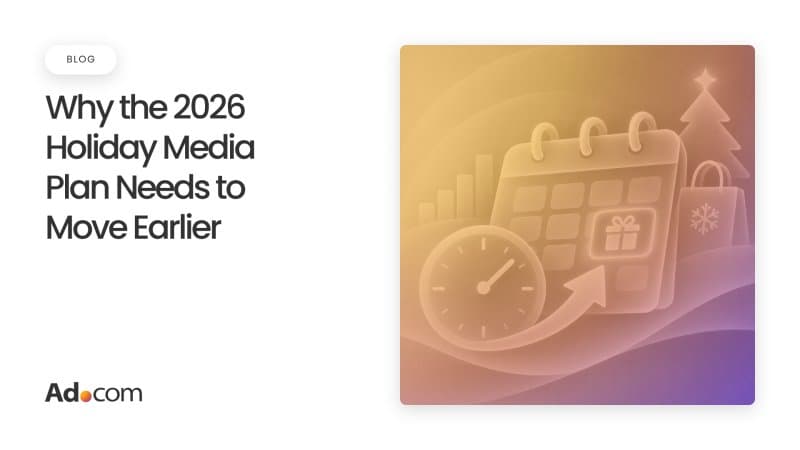
Why the 2026 Holiday Media Plan Needs to Move Earlier
Quick takeaway
- Moving the budget earlier buys inventory before bid prices climb.
- Holiday forecasts show which categories the feed should lead with, and campaigns that start in October reach shoppers while they are still researching.
- Activating Ad.com Shopping solutions live catalog feeds in publisher search results and on editorial pages, where those shoppers already are.
Senior advertisers and agency leaders have less time to decide this year, because shopping keeps sliding into October and November. Launching the main retail push during Cyber Week usually means peak cost per click, tight inventory, and missed high-intent buyers. A pre-Cyber Week plan means getting product feeds, search inventory, and shopping campaigns in place weeks before demand peaks.
The 2026 holiday forecasts, what early shopping changes about media buying, a checklist for activation, and how Ad.com Shopping connects a live catalog feed to publisher inventory.
What Are Holiday Sales Forecasts?
Holiday forecasts are predictions of retail sales over the November/December period. They are published by groups like the National Retail Federation and Adobe Digital Insights and utilise macro-economic data, sales data, and panel data to predict overall retail sales figures, online growth, and category demand.
Agencies use them to set category budgets, decide which products the feed should push, and book contextual shopping placements before Cyber Week inventory gets expensive. Last-touch results from prior years arrive too late to shape those decisions.
Five Trends Set to Shape Holiday 2026 for Advertisers
Based on the fact that consumer discovery will be distributed across more digital channels in Q4 2026, five trends will impact media planning:
- Earlier windows: Buyers start researching and buying in mid-October, which moves demand outside the five-day Cyber window.
- AI-driven product discovery: Conversational and visual search answer product questions directly, so users see fewer traditional results pages on the way to a decision.
- Contextual commerce: Publisher site search widgets and native feeds inside articles now capture purchase intent outside social platforms and search engines.
- Mobile: Phones carry more than half of all digital transactions, so carousels have to load quickly and resize for small screens.
- Feed syncing: Automated feeds need current prices and stock. Without them, click spend goes to sold-out items.
Holiday 2026 in numbers
Metric | 2026 Projection | Source |
Total U.S. Holiday Retail Spend | $1.013 trillion (+4.2% YoY) | NRF Holiday Retail Forecast |
Total U.S. Online Holiday Spend | $275.1 billion (+6.7% YoY) | Adobe Digital Insights |
Cyber 5 Online Sales Window | $47.5 billion (+7.4% YoY) | Adobe Cyber 5 Benchmark Data |
Early October Promotional Activity | $10.0 billion online spend | Adobe Early Retail Trends |
Ad.com Network Performance Lift | 31% to 57% ROI lift |
How Advertisers Should Prepare: The Holiday 2026 Media Playbook
Deploying retail ads in late November means buying when the auction is most crowded. The 2026 benchmarks show why starting earlier costs less. Thanksgiving through Cyber Monday still matters, but October promotions now generate more than $10 billion in e-commerce spending on their own.
"Early promotional events and AI-driven product discovery are redefining holiday shopping journeys. Retailers who optimize product catalog feeds and contextual placements before Cyber Week lock in higher-intent buyers at lower acquisition costs," said Vivek Pandya, lead analyst at Adobe Digital Insights, in the 2026 holiday forecast report.
Evaluating Early Shopping Behavior and Feed Readiness
Research moves earlier each autumn as shoppers look for value and try to avoid shipping delays. A U.S. Census Bureau retail trends report and Adobe consumer surveys both show shoppers using AI discovery tools and publisher search weeks before Black Friday.
Under a delayed strategy, brands hold budget back for Cyber Week and meet high CPMs, tight pacing caps, and unoptimized feeds. Earlier activation puts live catalog feeds and contextual shopping units in front of shoppers in late October and early November, which builds consideration and a retargeting pool before peak spending.
Four things carry the performance of an early catalog:
- Feed accuracy: Prices, stock, and promotional tags in the feed match the landing page.
- Category alignment: Budget follows growth: Electronics ($51.3 billion) and Furniture ($33.4 billion).
- Mobile readiness: Carousels sized for small screens, where more than half of holiday research happens.
- Placement reach: Catalog visibility inside editorial product roundups and site search feeds.
Pre-Cyber Week Framework: What Marketers Should Test and Change
Set up these tests in October and early November, then measure conversion rates on the placements against standard search results.
- Audit the live feed: Ensure that product images, copy, inventory, and GTINs are correct within the Catalogue Management System.
- Early consideration: Run early consideration campaigns 3-4 weeks before Thanksgiving. Include contextual carousels with recommended placements.
- Segment category holdouts: Through geo matching, we can see how much extra revenue has been made from shopping inventory vs. regular search ads.
- Bid adjustments based on peak times: Instead of daily max bids, apply bid adjustments based on the velocity of inventory in peak times.
Counterpoint and Strategic Limitations
Early deployment only works if supply keeps up. When availability moves or a promo code changes without the feed, the extra traffic lands on pages that no longer match the ad, and bounce rates and wasted spend follow. Automated syncing is what stops a campaign from advertising out-of-stock SKUs.
Activating Qualified Shopping Intent with Ad.com
Ad.com Shopping activates product feeds across publisher inventory:
- Live feed activation: Product data becomes shopping carousels and cascade units on publisher sites.
- Scale: 1 million trusted domains, 150,000+ premium web properties, and 100M+ daily impressions.
- Formats: Search Feed Ads, Shopping Carousels, and Native Suggest Units.
- Performance: Ad.com benchmarks 31% to 57% better performance and return on ad spend than standard digital channels.
Combining the live catalog with first-party audience signals is how retail brands turn early intent into revenue.
Conclusion
Moving budget earlier changes what inventory costs in Q4, since demand builds from October. By Cyber Week, a feed needs current prices and stock.
Test early activation against a holdout before committing. Moving spend into contextual channels earlier in the season reaches customers before holiday ad costs climb. Ad.com Shopping Solution is where the feed plugs in.
Frequently Asked Questions
How do early holiday sales forecasts affect agency media allocation?
NRF and Adobe publish category benchmarks that agencies can act on weeks before Cyber Week. Reviewing early demand indicators lets media planners move budget into rising categories and lock in lower CPMs before auction competition raises costs.
Why does product feed readiness matter before Cyber Week?
Feed readiness means prices, stock, promotional tags, and images sync automatically between the e-commerce catalog and the ad placements. Wrong data during peak traffic gets ads disapproved, spends clicks on out-of-stock items, and produces bad experiences on publisher sites.
What are native shopping suggested ads?
They appear as users type into publisher search bars, browser tiles, or shopping widgets. Matching a live offer to the query takes the shopper to a relevant product page with fewer steps.
How do marketers measure incrementality?
Set up geo-matched holdout regions: the new channel runs in the test regions, while control regions keep baseline spend. The gap in net-new conversions between the two is the lift the placements produced.
Can contextual shopping placements run without third-party cookies?
Yes. They read page content, article context, and immediate product category interest, with no third-party identifiers involved. Running a relevant product ad beside related editorial content keeps the purchase relevance while staying within privacy rules.